
Home / Motor & Controller / Permanent Magnet Synchronous Motors

Permanent Magnet Synchronous Motors

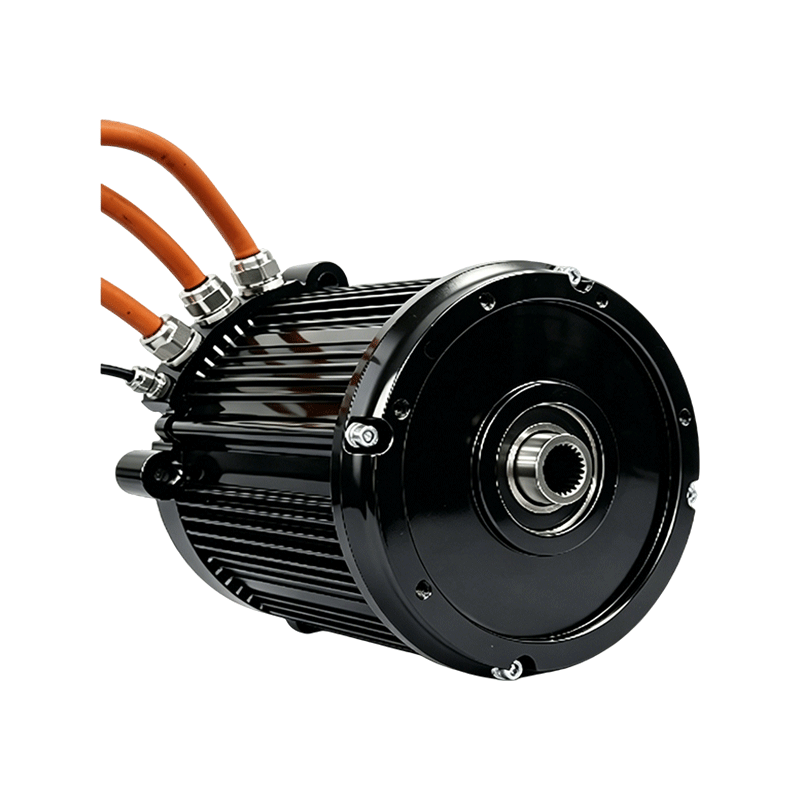
Permanent Magnet Synchronous Motors (PMSMs) utilize high-performance permanent magnets and an optimized electromagnetic structural design to achieve high efficiency, high power density, and superior dynamic response capabilities.
In terms of structure and manufacturing, the motors feature a stator-rotor assembly laminated from high-grade silicon steel sheets. This design, combined with precision winding techniques and a low-loss magnetic circuit configuration, effectively minimizes both iron and copper losses, thereby enhancing overall energy efficiency.
The motor housing is constructed from high-strength aluminum alloy or cast iron, balancing excellent heat dissipation with robust mechanical strength. Furthermore, the design incorporates superior protective capabilities, making the motors suitable for deployment across a wide variety of environmental applications.
We offer customized development services—including power density optimization, cooling system design, and control strategy integration—to provide our clients with Permanent Magnet Synchronous Motor solutions characterized by high reliability, exceptional consistency, and readiness for scalable mass production.

About
Zhejiang Jiuzhou New Energy Co., Ltd.

Zhejiang Jiuzhou New Energy Co., Ltd. was established in 2000. It is a professional manufacturer of new energy drive motors and control systems, specializing in the field of permanent magnet DC motors and controllers. It is a new energy technology enterprise integrating R&D, production, and sales. Based on a fully independent production chain of core components and in-depth research in the power system field of electric two-wheelers, we provide motor and controller solutions for industries such as electric vehicles, robots, water pumps,s and fans. It is in a well-known position in the global field of electric two-wheeler drive motors. It has three major manufacturing bases in Zhejiang, Jiangsu,su and Chongqing. Among them, the company's headquarters is located in Zeguo Town, Wenling City, Taizhou City, Zhejiang Province, with an annual output value of over 1 billion yuan.

Relying on the company's strong industrial chain and scale advantages, a complete modern management system, strong independent research and development capabilities, advanced production equipment, and a professional management team, the company's products are of excellent quality. It has successively passed professional and authoritative certifications such as ISO9001 Quality Management System, IATF16949:2016 Automotive Quality Management System, ISO14001 Environmental Management System, ISO45001 Occupational Health and Safety Management System, IPMS Intellectual Property Management System, Two-in-One Integration Standardization System, CQC, 3C, and CE. It has nearly two hundred national patents. It has successively won honors and qualifications such as "National High-tech Enterprise", "National Specialized, Refined, Unique and Innovative 'Little Giant' Enterprise", "National Intellectual Property Demonstration Enterprise", "National Postdoctoral Workstation", "Provincial Enterprise Research Institute", "Provincial Enterprise Technology Center", "Zhejiang Province AAA-level Contract-abiding and Creditworthy Enterprise", "Zhejiang Manufacturing Quality Product", and "Zhejiang Province Digital Workshop". The company's products sell well both at home and abroad, and have gained the trust of many partners and users. It has now become a well-known brand in the field of power systems for electric two-wheelers in China.

Jiuzhou New Energy Technology takes "providing advanced power systems for electric drive products" as its corporate mission. It has always been dedicated to the independent research and development and technological innovation of electric vehicle drive systems, committed to providing customers with complete system solutions for electric drive products, providing high-quality power for green travel, and steering the industry towards energy conservation, environmental protection,n and high quality.


Certificate Of Honor
  • High-Tech Enterprise
  • National High-Tech Enterprise
  • National Specialized, Refined, Unique and Innovative
  • National Intellectual Property Demonstration Enterprise
  • National Intellectual Property Advantage Enterprise
  • Postdoctoral Research Center
  • Zhejiang Provincial Enterprise Technology Center (Bronze Plaque)
  • Provincial-level Enterprise Research Institute (Bronze Medal)
  • Provincial High-tech Enterprise Research and Development Center Bronze Medal
  • Model Unit for Building a Clean and Honest Private Enterprise in Zhejiang Province in 2023
  • Zhejiang Province AAA-level
  • Zhejiang Provincial Postdoctoral Research Station
What's New
  • Industry News - Jul 31, 2026
    Electric Bike Controller Improves Vehicle Integration
    An Electric bike controller is often described as the brain of an electric bicycle. While the motor provides movement, the controller determines how power is delivered, how different electrical components communicate, and how the riding system responds to rider input. For bicycle manufacturers and component buyers, controller selection has become an important part of overall vehicle design rather than a simple accessory choice. Control Logic Shapes Overall Vehicle Performance An Electric bike controller receives signals from several components and calculates how much current should be supplied to the motor. Information may come from the throttle, pedal assist sensor, brake sensor, battery management system, display, and speed sensor. Instead of sending constant power, the controller adjusts output many times every second according to riding conditions and rider commands. This allows acceleration to feel smooth while helping different electrical components operate together. Common controller functions include: Motor speed regulation Current management Pedal assist processing Throttle signal control Brake cut-off response Battery communication Fault detection Depending on the vehicle platform, controllers may also support programmable riding modes and communication with LCD or LED displays. Component Selection Influences Manufacturing Quality Inside an Electric bike controller, electronic components work together to manage electrical power efficiently. The printed circuit board serves as the central platform, connecting processors, capacitors, resistors, power transistors, communication modules, and protective circuits. Power MOSFETs are among the key components because they switch electrical current rapidly during motor operation. Their layout, cooling design, and soldering quality all affect controller stability during continuous use. Manufacturers typically combine automated surface-mount technology (SMT) with manual inspection before final assembly. Heat dissipation is another important consideration. Aluminum controller housings are commonly used because they help transfer heat away from internal electronic components. Typical production procedures include: Production Stage Primary Purpose PCB assembly Install electronic components Program loading Write control software Functional inspection Verify electrical operation Communication testing Check signal transmission Output verification Confirm motor response Final assembly Complete enclosure installation These manufacturing steps help improve consistency across production batches and support long-term supply requirements for bicycle manufacturers. Electric Bike Controller Applications The Electric bike controller supports a wide variety of electric bicycle designs and commercial mobility products. Different vehicle categories require different controller characteristics based on motor configuration, battery capacity, and riding purpose. City commuter bicycles generally use compact controllers designed for smooth acceleration and efficient daily operation. Cargo bicycles often require controllers capable of handling higher current because heavier loads place greater demand on the drive system. Other common applications include: Folding electric bicycles Mountain electric bicycles Shared mobility fleets Delivery bicycles Touring bicycles Utility electric bicycles Three-wheel electric cargo bikes Many controller manufacturers provide several hardware versions that support hub motors as well as mid-drive systems. This allows OEM customers to select compatible products without redesigning surrounding electrical components. OEM Buyers Value Compatibility and Custom Development For B2B buyers, selecting an Electric bike controller involves much more than reviewing electrical specifications. Compatibility across the complete vehicle platform is often a deciding factor during supplier evaluation. Manufacturers frequently request controllers that match existing battery voltages, communication protocols, display interfaces, and motor configurations. A controller that integrates smoothly into current production can reduce engineering time during new product development. Common customization requests include: Different voltage platforms Adjustable current settings Waterproof connector options Customized wiring harnesses Communication protocol selection Software parameter adjustment Private label branding Engineering support is equally valuable. During sampling and pilot production, buyers often work closely with suppliers to fine-tune controller parameters for specific bicycle models before entering larger production runs.
    Browse More
  • Industry News - Jul 24, 2026
    Can One Hub Motor Factory Cover Multiple Vehicle Types?
    Anyone who has ridden a poorly built electric bike knows the difference immediately — jerky power delivery, odd noises at low speed, a motor that seems to strain going up hills it should handle easily. A lot of that experience traces directly back to the factory that built the hub motor, long before the bike ever reaches a showroom floor. Why Factory Selection Matters So Much A hub motor looks simple from the outside — a wheel with a motor built into the center. Inside, though, the winding quality, magnet alignment, and bearing tolerances determine how smoothly that motor performs over thousands of charge cycles. A factory that cuts corners on winding consistency or uses inconsistent magnet grades produces motors that might test fine individually but show wide performance variation across a production batch. That variation is exactly what distributors want to avoid when placing bulk orders meant to supply multiple retail partners. What Buyers Actually Evaluate Procurement teams sourcing from a hub motor factory tend to focus on a fairly consistent set of details: Winding and coil consistency across units, since small variations translate directly into differences in torque and efficiency Bearing and axle tolerance, which affects noise levels and long-term wear under repeated load Suppliers who can walk buyers through their quality control process on both points tend to earn more trust than those offering only finished-product specs without visibility into how consistency gets maintained during production. Application Scenarios Across the Industry Hub motors from these factories end up in a wider range of products than people often assume. E-bikes represent a large share of demand, spanning commuter models, cargo bikes, and off-road builds, each requiring different torque and speed characteristics. Electric scooters rely on smaller, higher-RPM hub motors suited to their compact wheel size. Light electric mobility devices — wheelchairs, mobility scooters, some warehouse equipment — also draw on hub motor technology, though with different priorities around load capacity and low-speed torque. A factory capable of adjusting winding specifications and housing dimensions across these categories gives distributors more flexibility when serving multiple client types from one supplier relationship. Common Pain Points in Sourcing Hub Motors A recurring frustration among distributors is receiving a sample unit that performs well, only to find wider performance variation once the full bulk order arrives. This usually points back to inconsistent quality control during scaled production rather than any flaw in the original design. Buyers who request batch testing data — not just single-unit specs — tend to catch this problem before it becomes a customer-facing issue. Noise and vibration are also common complaints tied to hub motor quality. A motor with uneven magnet spacing or slightly misaligned bearings can develop a faint hum or vibration that isn't obvious in a quiet testing environment but becomes noticeable during actual riding conditions. Factories that test units under load, rather than only at idle, tend to catch these issues before motors ship out. Heat management under sustained use is another factor buyers ask about, particularly for cargo e-bikes or delivery-oriented vehicles that run motors for extended periods without rest. A hub motor factory that can speak clearly to how their winding design and housing material handle heat buildup tends to inspire more confidence than one offering vague assurances about general durability.
    Browse More
  • Industry News - Jul 17, 2026
    Electric Bicycle Motor Production Focuses on Precision
    The electric bicycle industry continues to attract attention from bicycle brands, distributors, and OEM buyers looking for dependable drive systems. At the center of every electric bike is the Electric bicycle motor, a component that directly influences riding performance, product positioning, and manufacturing decisions. As demand grows across commuter bikes, cargo bicycles, folding models, and recreational products, motor manufacturers are investing in refined production methods and broader product ranges. Buyers are paying closer attention to efficiency, compatibility, and production consistency rather than simply comparing power ratings. Motor Structure Reflects Different Product Goals An Electric bicycle motor converts electrical energy from the battery into mechanical power that assists the rider. Although the basic working principle remains the same, several motor layouts are available for different bicycle designs. Hub motors remain popular because they integrate directly into the wheel, simplifying bicycle assembly. Front hub motors are commonly selected for lightweight city bicycles, while rear hub motors are often used where stronger traction is preferred. Mid-drive motors are installed near the bicycle's crankset. Instead of driving the wheel directly, they transfer power through the bicycle's drivetrain. This arrangement allows the motor to take advantage of the bike's gears, making it suitable for applications that involve varying terrain or heavier loads. Motor selection typically considers several technical factors: Rated power Rated voltage Torque output Motor weight Waterproof construction Noise level Controller compatibility Rather than focusing on a single specification, OEM buyers usually evaluate how these elements work together within the complete bicycle system. Manufacturing Focuses on Stable Quality and Precision Producing a reliable Electric bicycle motor involves multiple precision manufacturing processes. Consistent machining and assembly help reduce vibration, improve efficiency, and support long operating life. The production process generally includes stator winding, rotor machining, shaft processing, bearing installation, housing machining, controller integration, and final testing. Permanent magnets are carefully positioned to maintain balanced magnetic fields. Automated winding equipment improves consistency between production batches, while CNC machining helps maintain tight dimensional tolerances for motor housings and rotating components. Modern production lines also include dynamic balancing before final assembly. Even minor imbalances inside the rotor may increase operating noise or reduce efficiency. Several inspection items are commonly completed before shipment: Inspection Item Purpose Electrical performance Confirms stable power output Torque testing Verifies driving capability Noise measurement Checks operating smoothness Temperature testing Evaluates thermal stability Waterproof verification Confirms enclosure integrity Functional testing Ensures complete system operation Consistent manufacturing processes help suppliers provide repeatable quality across large production volumes, which is an important consideration for bicycle brands sourcing components internationally. Buyers Compare Integration and Supply Capability B2B buyers often evaluate more than motor specifications when selecting a supplier. The ability to support stable production schedules, customization projects, and technical cooperation has become increasingly important. Many bicycle manufacturers prefer suppliers capable of offering integrated solutions, including motors, controllers, displays, wiring harnesses, and matching accessories. This simplifies sourcing and helps reduce compatibility concerns during product development. Customization requests commonly include: Different motor power levels Customized wheel sizes Cable length adjustments Connector selection Software parameter configuration Private label branding Production flexibility also matters. Some buyers require large-volume manufacturing for established product lines, while others seek smaller production runs during new model development. Technical documentation, engineering support, and consistent communication throughout sampling and production stages for Electric bicycle motor orders often influence purchasing decisions alongside manufacturing capability.
    Browse More
  • Industry News - Jul 15, 2026
    Motor Cooling Technologies – Air Cooling vs. Liquid Cooling
    Motors generate significant heat during operation, and cooling performance directly affects efficiency, lifespan, and reliability. The two mainstream cooling methods are air cooling and liquid cooling. Air cooling uses air as the cooling medium, with fans generating airflow to dissipate heat. Its advantages include simple structure, low cost, and easy maintenance, making it suitable for low-power or low-heat applications. Liquid cooling, on the other hand, uses liquids such as water or oil with high specific heat capacity to absorb heat. The coolant circulates through pipes, quickly carrying heat away from the motor interior. Compared with air cooling, liquid cooling offers better thermal stability and temperature control, especially for high-power-density motors and new energy vehicle drive motors that demand superior cooling. Both technologies have their own applicable fields. Choosing the right cooling solution based on motor power density and application scenario is key to ensuring long-term stable operation.
    Browse More
  • Industry News - Jul 15, 2026
    Motor Efficiency Upgrades – What Does the IE5 Standard Bring?
    Motor efficiency classes are important indicators of energy-saving performance. From IE1 to IE5, the efficiency level increases progressively, with IE5 recognized as a high-efficiency class in current international standards. Data shows that IE5 motors reduce losses by about 40% compared with the commonly used IE3 motors. Taking a 15kW 4-pole motor as an example, upgrading from IE3 to IE5 ultra-high efficiency motor can save more than 4,000 kWh of electricity per year, reducing annual CO₂ emissions by 2.9 tons. IE5 motors offer an average efficiency improvement of about 1.3% over IE4 and about 2.9% over IE3. Driven by global carbon neutrality goals, countries are continuously raising the entry barriers for motor efficiency. High-efficiency motors not only reduce electricity costs but also contribute to sustainable development, becoming a key element in the green transformation of industrial and transportation sectors.
    Browse More
  • Industry News - Jul 15, 2026
    Hub Motor vs. Mid-Mounted Motor – How to Choose?
    The power core of electric two-wheelers mainly falls into two types: hub motors and mid-mounted motors, each with distinct structural designs and application scenarios. Hub motors are installed directly in the center of the rear wheel, with fewer moving parts, offering low cost, easy maintenance, and good range performance – ideal for daily commuting on flat urban roads. Mid-mounted motors are placed in the middle of the frame and drive the rear wheel via a chain or belt. This layout provides better weight distribution and higher torque output, with faster acceleration response, making it suitable for high-performance e-motorcycles and riding on complex terrain. When choosing, consumers can decide based on their daily riding environment and performance needs: for economical and practical use mainly on flat roads, hub motors are a good choice; for challenging terrain and a more dynamic riding experience, mid-mounted motors are more appropriate.
    Browse More
  • Industry News - Jul 15, 2026
    Why Are Permanent Magnet Synchronous Motors Becoming the Mainstream Choice?
    In the field of electric drive, permanent magnet synchronous motors (PMSM) have become the mainstream choice for a wide range of applications due to their outstanding performance. Compared with traditional motors, PMSMs embed permanent magnet materials in the rotor. During normal operation, the rotor and stator magnetic fields run synchronously, with no induced current in the rotor windings, eliminating rotor resistance and hysteresis losses, thus significantly improving motor efficiency. At the same time, permanent magnets replace the electric excitation structure in traditional induction motors, bringing advantages such as high torque at low speeds, high power factor, compact size, low noise, and high reliability. Currently, PMSMs are widely used in e-bikes, robots, CNC machine tools, fans, pumps, and more. With continuous improvements in magnet performance and cost optimization, this technology is evolving toward higher power, higher functionality, and miniaturization.
    Browse More
  • Industry News - Jul 10, 2026
    Electric Motorcycle Motor Manufacturers Focus on Efficient Design
    The electric mobility sector continues to introduce new vehicle models for urban transportation, recreational riding, and commercial delivery. As demand for electric motorcycles grows across different markets, Electric motorcycle motor manufacturers are refining production methods and engineering solutions to meet changing design requirements. Rather than producing one standard motor, manufacturers now develop multiple motor configurations that match different riding styles, vehicle sizes, and performance expectations. Motor production has become a combination of precision machining, digital engineering, and flexible manufacturing. This approach allows vehicle builders to select motors that fit both technical requirements and product positioning while keeping development schedules moving efficiently. Flexible Motor Designs Support Diverse Applications Modern electric motorcycles serve many purposes, from daily commuting to utility transportation. Because every vehicle has different power and space requirements, manufacturers provide motors in various dimensions and output ranges. Several design factors receive careful attention during development: Compact motor structures that simplify vehicle integration Multiple power ratings for different motorcycle categories Air-cooled or liquid-cooled configurations Hub motors and mid-drive motors for different layouts Stable torque delivery across varying riding conditions Offering multiple configurations gives motorcycle designers greater flexibility when balancing vehicle weight, acceleration, battery capacity, and overall riding characteristics. Precision Manufacturing Improves Product Consistency Manufacturing technology plays an important role in motor production. Automated machining equipment produces key components with consistent dimensions before assembly begins. Rotor balancing, stator winding, shaft machining, and housing production all contribute to the finished motor's operating stability. Many Electric motorcycle motor manufacturers also integrate automated inspection during assembly. Digital measurement equipment checks component alignment while production systems monitor important manufacturing data throughout each stage. Computer-controlled production helps reduce variation between motors, making it easier for motorcycle manufacturers to maintain consistent vehicle performance across larger production volumes. Engineering Teams Focus on Efficient Integration Motor development now extends beyond the motor itself. Engineering teams frequently work alongside motorcycle designers to improve compatibility between the motor, battery system, transmission, and electronic controller. Attention is often given to areas such as thermal management, compact installation space, vibration control, and electrical connections. Careful coordination between these systems supports smoother vehicle operation and simplifies final assembly. Digital simulation software also allows engineers to evaluate motor behavior before physical prototypes are produced. Virtual testing shortens development cycles while providing opportunities to adjust internal structures, magnetic layouts, and housing designs during early design stages. Manufacturing Flexibility Supports Global Customers Today's motorcycle market includes established vehicle brands, startup companies, and specialized manufacturers producing vehicles for different industries. As customer requirements continue to vary, Electric motorcycle motor manufacturers are expanding their production flexibility. Many factories now offer: Customized motor dimensions for specific vehicle platforms Various controller matching solutions Multiple shaft and mounting configurations Branding and appearance customization for OEM projects Flexible production planning also allows manufacturers to manage both large-volume production and smaller development orders. This capability supports customers introducing new vehicle models while maintaining efficient factory operations. As electric motorcycles continue appearing in more transportation segments, motor manufacturers remain focused on engineering accuracy, adaptable production, and practical product development. Their combination of precision manufacturing, flexible customization, and collaborative engineering provides motorcycle companies with dependable motor solutions for a wide variety of vehicle designs. Continuous refinement in production technology and design capability keeps Electric motorcycle motor manufacturers closely connected to the evolving needs of the electric motorcycle industry.
    Browse More
  • Industry News - Jul 03, 2026
    Which Hub Motor Kit Setup Fits Your Riding Style?
    For riders who already own a bicycle they love but want a boost of electric power, hub motor kits offer a straightforward path forward. Rather than buying an entirely new e-bike, a hub motor kit lets someone convert an existing frame into a motorized ride, keeping the bike they're used to while adding pedal assist or throttle-based power. What's Included in a Typical Kit A standard hub motor kit centers around a motorized wheel hub, which replaces either the front or rear wheel of the bicycle. Beyond the hub itself, kits usually include a controller, a battery pack, a display or control panel, wiring harnesses, and sometimes a pedal-assist sensor. Some kits arrive with the motor already laced into a rim, ready to bolt on, while others require the buyer to build the wheel themselves using their own rim and spokes. Front-Wheel vs Rear-Wheel Setups One of the decisions buyers face is whether to choose a front hub motor or a rear hub motor. Front hub kits are often easier to install, since they don't interfere with the bike's existing gearing or chain system. Rear hub kits tend to offer more balanced weight distribution and better traction, particularly on inclines or loose surfaces, since more of the rider's weight naturally sits over the rear wheel. Neither option is universally better; the right choice depends on the bike's frame, intended use, and the rider's comfort with installation. Motor Power and Riding Feel Hub motor kits come in a range of power outputs, typically measured in watts, and this figure has a direct effect on how the bike feels to ride. Lower-wattage motors tend to suit flat commuting routes and casual riding, offering smooth assistance without overwhelming the pedaling experience. Higher-wattage motors provide stronger torque, which can help with hill climbs or carrying extra cargo, though they also draw more from the battery and may require a sturdier frame to handle the added stress. Battery Compatibility and Range Factors Battery packs paired with hub motor kits vary by voltage, amp-hour rating, and mounting style, with options that clip onto the frame, sit in a rear rack, or tuck into a downtube-style casing. Range depends on several factors working together, including battery capacity, motor wattage, terrain, and how much the rider relies on throttle versus pedal assist. Buyers sourcing kits for resale or fleet use often ask about compatibility between specific battery voltages and controller specs, since mismatched components can affect performance. Installation Considerations for Buyers Installing a hub motor kit generally involves swapping out a wheel, mounting the battery and controller, and connecting the wiring to a display unit on the handlebars. While many kits are designed for home installation with basic tools, frame compatibility matters — disc brake mounts, dropout width, and axle type all need to line up with the kit being used. This is a common area where buyers request technical specifications upfront, particularly when sourcing kits for a specific bike model or a batch of mixed frame types. A Flexible Option for Electrifying Existing Bikes Hub motor kits continue to appeal to riders and businesses looking for a practical middle ground between a traditional bicycle and a full e-bike purchase. By separating the motor system from the frame itself, these kits give buyers room to customize power levels, battery size, and wheel placement based on how and where the bike will actually be ridden.
    Browse More
  • Industry News - Jun 26, 2026
    Electric Bike Motor Performance Factors Explained
    Hub Motors vs. Mid-Drive Motors The fundamental distinction in electric bike motors is between hub-mounted and mid-drive configurations. Hub motors are integrated into the wheel — either the front or rear — and drive the bike by spinning the wheel directly. Mid-drive motors are positioned at the bottom bracket, between the pedals, and drive the chain rather than the wheel. Hub motors are widely used because they are mechanically straightforward, relatively easy to install, and compatible with a broad range of frame types. They operate independently of the bike's drivetrain, which means gear changes do not affect motor performance and drivetrain wear is reduced. Rear hub motors provide a more natural riding feel than front-mounted versions, which can affect handling under power on loose or uneven surfaces. Mid-drive motors interact with the bike's gearing system, which allows the motor to operate at a more consistent and efficient cadence across varied terrain. This makes them particularly suited to hilly riding and off-road applications where torque demands shift frequently. The trade-off is greater mechanical complexity and higher drivetrain wear compared to hub configurations. Power Ratings and What They Mean Electric bike motors are rated in watts, which reflects the motor's continuous power output under load. Common ratings across the segment include: 250W: Suited to flat urban riding, lighter riders, and markets where power output is restricted by local rules 500W: A practical middle range for mixed terrain, moderate hills, and heavier cargo loads 750W: Provides stronger hill-climbing capability and faster acceleration, common in North American market builds 1000W and above: Used in cargo bikes, off-road builds, and high-demand commercial applications where torque output takes priority over efficiency Peak wattage figures quoted in product listings often exceed continuous ratings by a significant margin. Buyers evaluating motors should focus on continuous rated power and torque figures rather than peak numbers, which reflect short-duration output rather than sustained performance. Torque and the Riding Experience Torque, measured in Newton-meters (Nm), determines how forcefully a motor responds when the rider calls for assistance. A motor with higher torque accelerates more readily from a stop, handles inclines with less strain, and responds more immediately to pedal input. Mid-drive motors generally produce higher torque figures than hub motors of equivalent wattage, which is one reason they are favored for technical terrain. Torque sensors and cadence sensors take different approaches to measuring rider input and triggering motor assistance. Torque-sensing systems measure the actual force applied to the pedals and scale motor output accordingly, producing a riding feel that riders describe as natural and intuitive. Cadence sensors detect whether the rider is pedaling and apply a fixed or stepped level of assistance, which is less nuanced but mechanically simpler and more cost-effective. Compatibility and Integration Considerations Electric bike motors do not operate in isolation. Key compatibility factors that affect how a motor performs in a complete build include: Battery voltage matching: Motors are rated for specific voltage ranges (typically 36V, 48V, or 52V), and mismatching voltage affects both performance and component lifespan Controller compatibility: The motor controller governs power delivery and must be matched to the motor's specifications Frame dropout width: Hub motor axle widths vary (commonly 135mm rear, 100mm front) and must correspond to frame spacing Display and sensor integration: Many motor systems use proprietary communication protocols that limit cross-brand component mixing Buyers sourcing motors for production builds or retrofit kits should confirm full system compatibility before committing to volume orders. A motor that performs well in isolation may behave differently when paired with an incompatible controller or battery management system. Where the Market Is Focused Cargo e-bikes, commuter builds, and off-road platforms are currently driving the bulk of electric bike motor demand across both consumer and commercial channels. Rear hub motors continue to account for a large share of volume due to their lower entry cost and broad compatibility. Mid-drive systems are gaining ground in performance-oriented and premium-tier builds where riding feel and hill-climbing capability justify the additional complexity. For procurement teams and OEM builders, motor selection remains one of the earlier and more consequential decisions in any e-bike development or sourcing process.
    Browse More
  • Industry News - Jun 19, 2026
    Electric Scooter Controller Tips for Smoother Daily Rides
    Electric scooter controllers function as the central processing unit for electric scooters. They regulate the flow of electricity from the battery to the motor, translating rider inputs into controlled movement. This component plays a key role in daily commuting, short trips, and recreational rides by ensuring smooth operation across different conditions. Basic Functions of the Controller The electric scooter controller receives signals from the throttle and other inputs, then adjusts power delivery to the motor accordingly. It manages acceleration, speed limits, and deceleration to match rider preferences and road situations. Many controllers include circuits that monitor voltage and current to support consistent performance during typical use. In practice, the controller handles transitions between starting from a stop, maintaining steady speeds in traffic, and slowing down at intersections. This coordination helps riders navigate urban environments with predictable responses. Types of Controllers in Use Electric scooter controllers come in different designs, such as brushed and brushless variants. Brushless controllers pair well with modern motors, offering efficient operation and reduced mechanical wear. Some models use sine wave technology for smoother power delivery, while others employ square wave approaches suited to specific torque needs. Controllers also vary in their amperage ratings and voltage compatibility. These specifications influence how the scooter responds under load, such as when carrying a rider and light cargo or climbing gentle inclines in city routes. Throttle Response and Speed Management Riders interact with the electric scooter controller primarily through the throttle mechanism. The controller processes these inputs to provide proportional power, allowing fine adjustments in speed for crowded sidewalks or bike lanes. Many systems include multiple riding modes that alter response sensitivity for different scenarios, such as relaxed neighborhood travel or faster stretches on dedicated paths. Speed management features help maintain safe and legal operating limits in public areas. The controller ensures gradual acceleration that feels natural, reducing abrupt movements that could affect balance. Role in Braking and Safety Features During braking, the electric scooter controller works with the scooter's mechanical or electronic brakes. It can modulate power to prevent wheel lockup and support smoother stops. Regenerative functions redirect some energy back to the battery when slowing down, contributing to ride duration in daily cycles. Display units connected to the controller show information like current speed, battery level, and mode selection. This feedback helps riders make informed decisions during operation without diverting attention excessively from the road. Applications in Urban Commuting Commuters often rely on electric scooters equipped with these controllers for short to medium distances. The controller supports quick starts at traffic lights and efficient cruising along regular routes. Its ability to handle repeated stop-and-go patterns makes it suitable for busy city streets and campus paths. Delivery riders use scooters with capable controllers to manage loads while maintaining steady paces through neighborhoods. The responsive nature aids in maneuvering around obstacles and adapting to changing traffic flows throughout a shift. Variations for Different Scooter Models Electric scooter controllers adapt to various scooter categories, from lightweight folding models for portability to larger commuter versions with higher power needs. Compact controllers fit slim frames designed for easy storage in offices or public transit, while more robust units support scooters built for longer range or varied terrain. Some controllers include connectivity options that link with mobile applications for monitoring ride data. This integration allows users to track usage patterns and adjust settings to align with personal routines, such as work commutes or weekend explorations. Handling and Ride Quality Aspects The electric scooter controller influences overall ride feel through its power mapping and response tuning. Smooth torque delivery contributes to stable acceleration and helps maintain traction on different pavement types. Riders often note the quiet operation that comes from well-coordinated motor control, enhancing awareness of ambient sounds. In group rides or shared mobility services, consistent controller performance supports predictable behavior across multiple units. This reliability aids in coordinating movements and reduces surprises during shared routes. Design Considerations for Everyday Reliability Manufacturers design electric scooter controllers with attention to heat dissipation during prolonged operation. Finned casings or internal fans in some models help manage temperatures on warmer days or during extended rides. The units undergo calibration to function across a range of ambient conditions encountered in seasonal riding. Component quality in the controller affects long-term consistency in power delivery and responsiveness. Standard mounting practices and protective enclosures contribute to durability under normal vibration and exposure levels typical of scooter use. Electric scooter controllers form an essential part of the modern personal electric vehicle experience. By directing power flow and coordinating system responses, they enable practical, manageable rides for commuting, errands, and leisure. Their engineering supports a wide variety of scooter designs and rider needs, contributing to the accessibility of electric two-wheeled transport in daily life.
    Browse More
  • Industry News - Jun 12, 2026
    Electric Motorcycle Motor Technologies Changing Two-Wheel Mobility
    Electric motorcycle motors serve as the central drive component in electric-powered two-wheelers. These motors convert electrical energy into mechanical motion, enabling smooth propulsion for daily commutes, city rides, and recreational outings. Their integration into motorcycle designs has expanded options for riders seeking responsive and efficient performance in various riding scenarios. Core Operation of Electric Motorcycle Motors Electric motorcycle motors rely on electromagnetic principles to generate torque. When current flows through the motor windings, it creates a magnetic field that interacts with magnets or coils in the rotor, producing rotational force. This direct drive approach delivers power instantly upon throttle input, supporting quick acceleration from a stop in traffic or during lane changes. Many motors operate with brushless designs, which reduce internal friction and support consistent output across different speeds. Riders often notice the quiet operation compared to traditional alternatives, allowing for clearer awareness of surrounding sounds during rides. Common Motor Configurations Several configurations appear in electric motorcycle applications. Hub motors place the drive unit directly in the wheel, simplifying the overall drivetrain and lowering the center of gravity for stable handling. Mid-drive motors, positioned near the bike's pedals or central frame, connect through a chain or belt system to distribute power effectively to the rear wheel. Each setup offers distinct characteristics in power delivery. Hub motors provide straightforward installation and direct response, while mid-drive versions allow for better weight balance and adaptability to different motorcycle frames. Integration With Motorcycle Frames Electric motorcycle motors fit into various frame designs, from sport-oriented models to cruisers and adventure styles. Engineers mount the motor in ways that maintain the bike's balance and steering geometry. The compact nature of many units leaves room for battery placement and other components without compromising the motorcycle's silhouette. Frame materials and motor mounting points work together to absorb vibrations during operation. This setup helps preserve rider comfort over longer periods in the saddle, particularly on uneven road surfaces common in urban and suburban routes. Performance Characteristics in Daily Use In city environments, electric motorcycle motors deliver progressive torque that supports stop-and-go traffic flow. The motors respond to throttle movements with controlled power, helping riders navigate intersections and maintain steady speeds in variable conditions. Regeneration features during braking can return energy to the system, extending ride duration in typical daily patterns. On suburban roads or highways, the motors sustain consistent speeds with minimal effort from the rider. The linear power curve allows for overtaking maneuvers when needed, while the absence of gear shifts simplifies operation for both new and experienced riders. Battery and Motor Coordination The interaction between the battery pack and electric motorcycle motor determines overall ride dynamics. Controllers manage energy flow to match rider inputs, ensuring smooth transitions between acceleration, cruising, and deceleration. This coordination helps maintain predictable behavior across temperature ranges and load conditions encountered during regular use. Motor efficiency plays a role in how effectively energy translates into motion. Designs that minimize heat buildup during extended operation support reliable performance on longer daily routes or weekend rides. Rider Experience and Control Features Riders interact with electric motorcycle motors through throttle controls and selectable ride modes. These modes adjust power output and response sensitivity to suit different situations, such as relaxed commuting or more engaged weekend exploration. The immediate torque availability creates a connected feel between rider and machine. Display interfaces often show real-time motor status and energy usage, helping users gauge their riding style. The quiet operation enhances the overall sensory experience, making conversations or music listening more feasible during group rides. Handling and Responsiveness Aspects The placement and characteristics of electric motorcycle motors influence the bike's handling profile. Lower-mounted units contribute to stability during turns and at higher speeds. Quick torque delivery supports precise adjustments in lean angle and line choice through corners. Suspension systems complement motor characteristics by absorbing road imperfections while the motor provides steady drive. This combination helps maintain composure in a range of riding conditions, from smooth pavement to lightly rutted paths. Design Trends in Motor Development Ongoing refinements in electric motorcycle motors focus on compact sizing, thermal management, and power density. Manufacturers explore materials that support durability under repeated thermal cycles and mechanical stress from riding. Modular designs allow for easier integration across different vehicle platforms. Weight reduction efforts help improve overall motorcycle agility without sacrificing output. These advancements continue to shape how motors fit into evolving motorcycle designs and rider expectations. Electric motorcycle motors play a central role in the functionality and appeal of modern electric two-wheelers. Their engineering supports practical daily use, varied riding styles, and consistent performance across different environments. As riders explore options in personal mobility, these motors provide a foundation for engaging and manageable experiences on the road.
    Browse More
Message Feedback
Permanent Magnet Synchronous Motors Industry Knowledge